

Codelco at a Crossroads
Structural challenges and new opportunities that could reshape global copper supply

Chile’s copper sector contributes about 14% to Chile’s GDP and 58% of the country’s exports. Often regarded as an example of state-led company and public-private cooperation, Codelco is currently facing a steep production decline while the need for investment — in new projects, innovation and clean energy — seems more and more urgent. I analyze those challenges in this edition’s Economic Focus.
The Market Radar section covers the ground: from the fiscal risks flagged in Kast's reform package, to a $4.45 billion port expansion, Chile's first rare earths project cleared for development, and a historic reinvention of the country's steel sector.
❐ ECONOMIC FOCUS
Codelco at a Crossroads: Production Crisis, New Leadership and Opportunities
Chile’s state copper giant is navigating one of the most turbulent periods in its recent history — and one of the most consequential for global copper supply. A production scandal, a leadership overhaul, a $24 billion debt pile, and a structural decline in output are arriving simultaneously, against a backdrop of elevated copper prices that should have been a windfall. The contrast is striking.
Leadership change
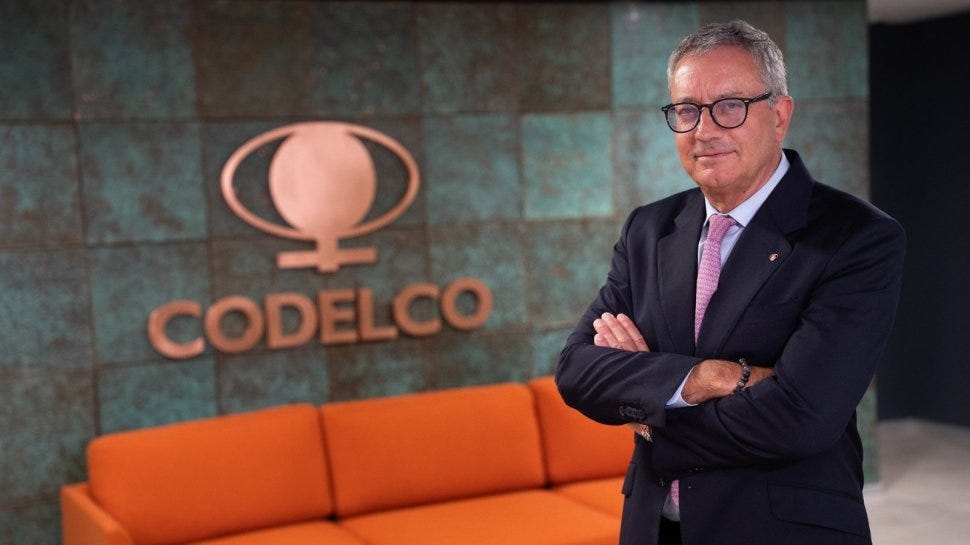
Bernardo Fontaine took over as chairman of Codelco’s board on May 27, replacing Máximo Pacheco. The appointment drew immediate scrutiny: Fontaine, an economist and former constitutional convention member, has no direct mining experience. The government framed the other new board appointments as complementary, making clear the mandate is institutional recovery rather than sector expertise.
The executive suite followed within days. On June 3, CEO Rubén Alvarado resigned, and the board named Jorge Gómez — former CEO of Collahuasi for 14 years, one of the most respected figures in Chilean copper mining — as his successor, effective July 13. His arrival from the private sector signals the direction Fontaine intends to take.
Fontaine’s own summary of the challenge is blunt:
“Codelco is running with a lead backpack. We need to lighten it.”
The numbers behind the crisis
Codelco produced 272,000 tonnes of refined copper in Q1 2026, down 8% from Q1 2025 and well below the company’s long-run quarterly average of around 362,000 tonnes. Production has fallen from approximately 1.7 million tonnes annually to around 1.3-1.4 million tonnes — a structural decline that persisted through the largest investment cycle in the company’s history.
The cost picture is equally difficult. Direct production costs rose from 133 to 208.6 cents per pound between 2021 and 2025. Total debt now stands at $24 billion, having grown by $7.4 billion in four years despite $17 billion invested in structural projects over the same period.
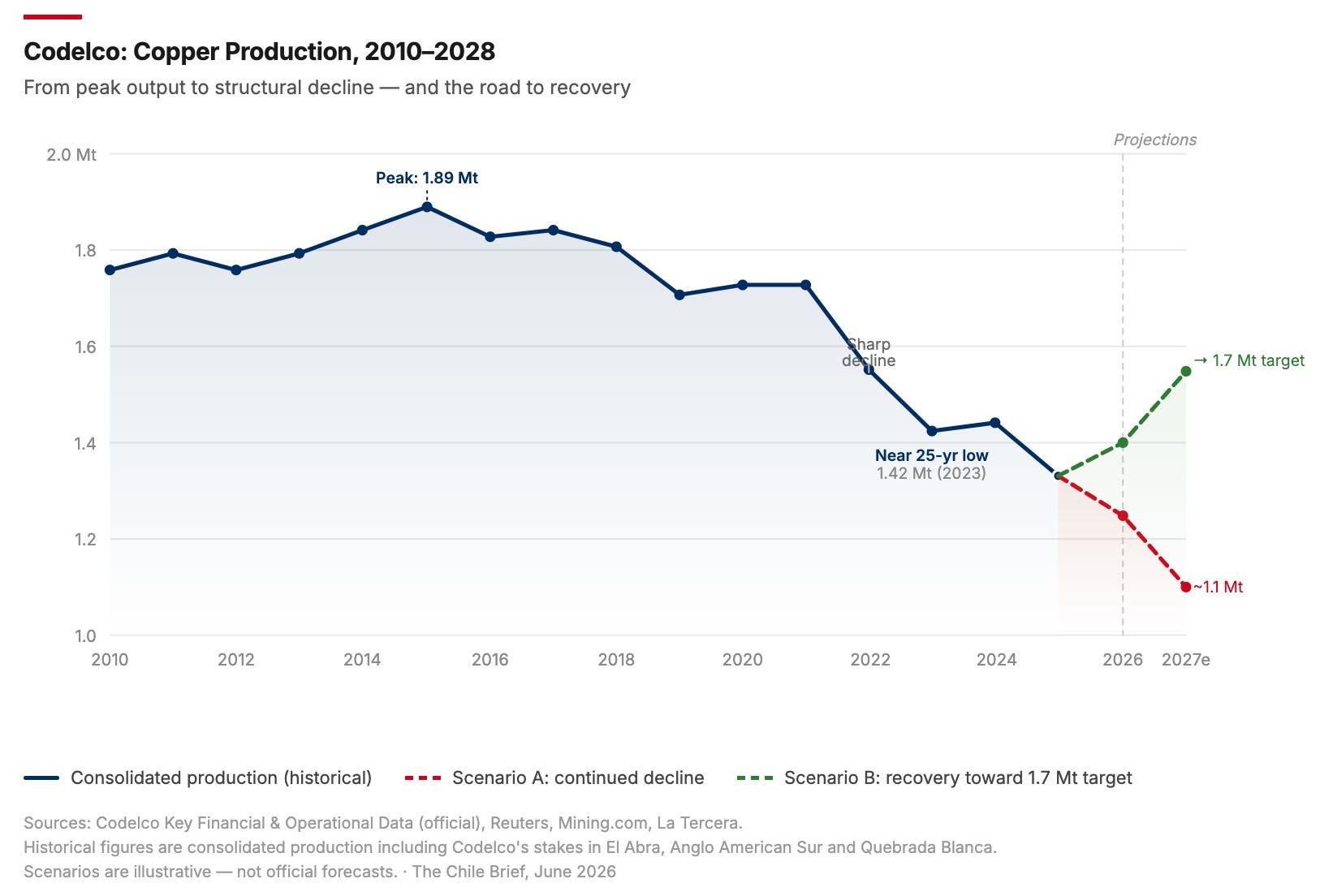
The decline in production is mainly explained by the aging of super-pits. Codelco operates some of the oldest mines in the world in which copper concentration has decreased significantly, meaning the company must mine, process, and mill more rock to yield the exact same amount of finished copper as before. Old mines are also prone to more temporary shutdowns wether because of maintenance or accidents. Meanwhile, several major investments in new mines have been delayed.
Then there is the scandal. An internal audit revealed that approximately 27,000 tonnes of copper had been irregularly incorporated into production figures in 2025, triggering the payment of $14.3 million in performance bonuses to over 6,000 employees and executives — funds the company is now seeking to recover. Unions at Chuquicamata have publicly stated they will not return the money.
What CESCO is recommending
Mining think tank CESCO, in a document addressed directly to Codelco’s new leadership, has called the situation “one of the worst crises in its history” and proposed four structural reforms:
Converting Codelco into a holding company, with individual operations restructured as subsidiaries, reflecting the argument that the company’s operational complexity far exceeds its organizational structure.
Separating corporate governance from the political cycle, ensuring that board members and strategy are not replaced with each new administration.
Shifting the focus from production volume to profitability, reviewing whether existing structural projects can be reformulated to reduce cost and increase returns.
Opening specific exploration projects to private capital and international stock exchanges: Toronto, London, and Australia are cited as references.
The privatisation debate remains politically closed for this congressional term: the government has explicitly ruled it out, and the Senate’s Mining Commission has signed a formal declaration in defense of Codelco’s status as a state enterprise. But the structural direction with more private partnerships, more financial discipline and a CEO drawn from the private sector, points to a gradual shift in how the company is managed.
New opportunities: Vicuña and the cross-border corridor
While Codelco navigates its internal crisis, a different copper story is taking shape along the Chile-Argentina border. Vicuña Corp., the 50/50 joint venture between BHP and Lundin Mining formed in January 2025, is developing the Filo del Sol and Josemaría deposits in Argentina’s San Juan province. After investing approximately $400 million in 2025, the company is planning to nearly double that to around $800 million in 2026.
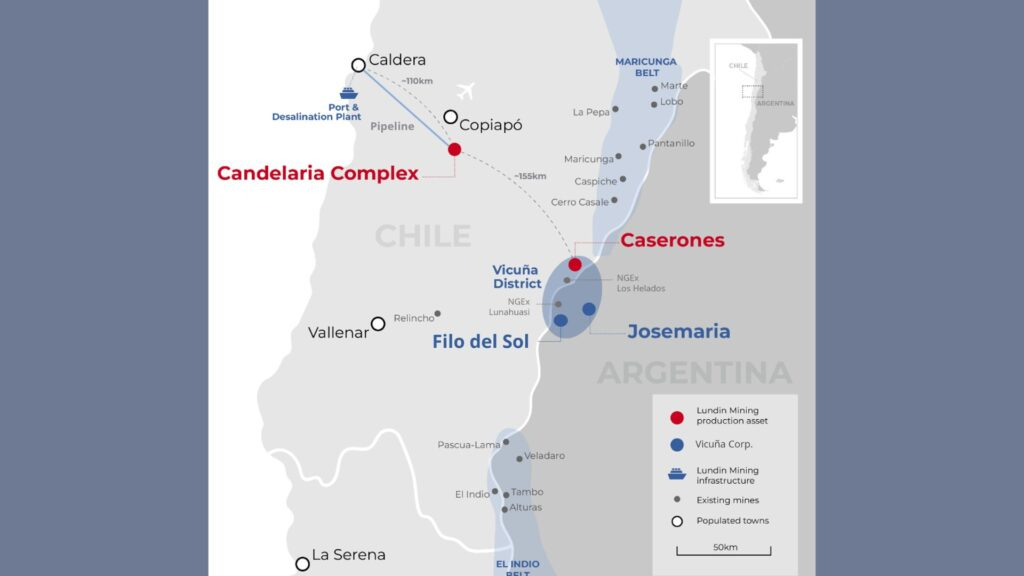
The scale is exceptional. The February 2026 Preliminary Economic Assessment projects average annual production of 400,000 tonnes of copper, 700,000 ounces of gold, and 22 million ounces of silver over the first 25 years, with a mine life estimated at over 70 years. A sanctioning decision could come as early as year-end 2026.
The broader corridor context adds weight to the story. At least seven advanced copper projects are targeting production by 2030 along the Chile-Argentina border, with combined potential investment approaching $21 billion. Argentina’s April 2026 reform of its Glacier Law has opened clearer regulatory pathways for high-altitude Andean development. A 1997 binational mining treaty is gaining new momentum, with working sessions scheduled through mid-2026.
The institutional challenge is real — but it coexists with a genuine modernisation drive. Last week, Exponor1 provided Codelco with a timely platform to reaffirm its commitment to the transitions that will define its next decade: the electrification of its underground fleet, the rollout of remote-operated equipment and digital twin technology across key divisions, and the broader push to phase out diesel in favour of clean energy sources. Agreements signed in recent months with international research partners to advance underground electrification point in the same direction.
The picture that emerges is of a company under genuine financial and governance pressure, but not standing still. The new leadership's task is to stabilise the balance sheet and restore institutional credibility without losing the technological momentum that positions Codelco as more than a legacy producer. Whether the incoming CEO, arriving in July from the private sector, can deliver on both fronts simultaneously is the central question for Chile's copper sector in the second half of 2026.
❐ CHILE MARKET RADAR
Kast's reform package faces independent scrutiny
Chile's independent Fiscal Council presented a sobering assessment to the Senate's Finance Committee last week. The council identified 11 fiscal risks in Kast's economic reform package and warned that "the project presents a deficit until at least 2031" — even accounting for projected growth effects. Its central concern: the reform "commits fiscal spending with considerable certainty in the short term and reduces permanent revenues, while the positive effects depend on more uncertain future income associated with growth". The corporate tax cut — from 27% to 23% — was specifically flagged as only 75% financed in steady state. (CNN Chile)
Puerto San Antonio clears environmental approval
Chile's environmental regulator granted unanimous approval for the expansion of Puerto San Antonio, with an investment of approximately $4.45 billion. The project will significantly expand the port's capacity, directly relevant for copper, lithium, and agricultural exporters who depend on Chile's central coast infrastructure. The unanimous nature of the approval — unusual for a project of this scale — signals the new government's permitting acceleration agenda producing early results. (Portal Portuario)
Antofagasta Minerals extends Zaldívar to 2051
Antofagasta Minerals announced a $900 million investment to extend operations at its Zaldívar copper mine through 2051. The decision reflects sustained confidence in long-term copper demand fundamentals, and adds to the picture of private sector mining investment accelerating under the new regulatory environment — even as Codelco struggles with its structural challenges. (Mining.com)
Huachipato reborn as a green steel operation
CAP and Aceros AZA signed an agreement to combine their steel businesses in a transaction valued at $484 million, integrating Huachipato's strategic assets with AZA's industrial model and scrap-based production. AZA takes 85% control, with CAP retaining 15%. The plan is to produce green steel emitting around 10 times less CO2 than the industry average, using recycled scrap and clean energy — with a new electric arc furnace potentially entering production in five to seven years. The deal is subject to competition authority review. (Emol)
Rare earths project clears environmental approval
The environmental commission of the Biobío region unanimously approved the EIA for the rare earths project developed by Aclara Resources and Grupo CAP in the municipality of Penco — a project that has been in development for nearly a decade and involves an investment of $130 million, with potential to create 2,200 direct and indirect jobs. Community groups, indigenous organisations and the local municipality have announced appeals to the Committee of Ministers and potential legal action, meaning the approval is not yet final. The project would be Chile's first rare earths operation — a significant signal for a country seeking to diversify beyond copper and lithium. (Bio Bio Chile)
The opinions and views expressed in this publication are solely those of the author. They do not represent, and should not be interpreted as representing, the official positions of any organization with which the author is or has been affiliated.
Exponor is a major mining trade show that takes place every two years in Antofagasta, north of Chile. This year’s edition took place between June 8th and June 12th.